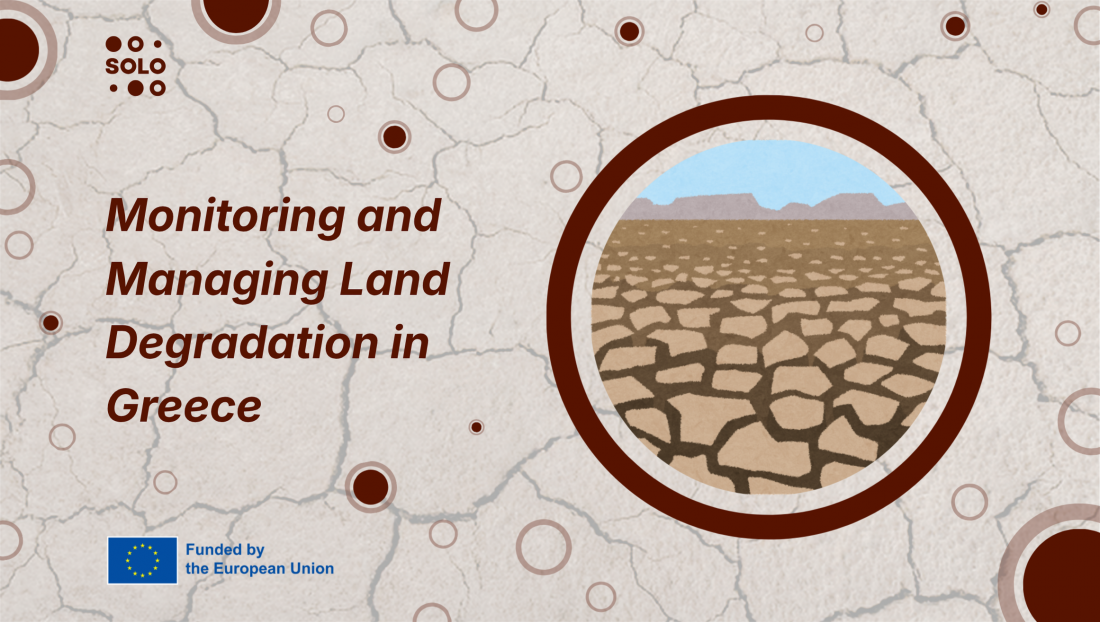
The National Observatory of Athens (NOA) hosted its 4th Soil Week event on 22 April. The webinar gathered between 15 and 20 participants, including university professors, researchers, students, and business representatives, to discuss harvesting experience from national and EU projects to benefit soil health preservation and monitoring in Greece.
The webinar highlighted the importance of strengthening soil sampling networks and improving overall data quality to support reliable soil health assessments. Participants emphasised that exploiting advanced technologies, such as Artificial Intelligence (AI), Remote Sensing, and big data systems, can significantly enhance the efficiency and accuracy of monitoring activities. Data exploitation and handling emerged as the most critical point of discussion, with experts calling for the creation of open-access repositories and national digital infrastructures for soil and climate data following the FAIR data principles.
During the discussion, the need to better inform and train farmers on sustainable practices while increasing the adoption of smart digital tools in agriculture was stressed. Bridging the gap between scientific knowledge and everyday agricultural practice is a key driver for reducing land degradation. Additionally, the webinar identified over-irrigation as a pressing issue, which directly affects soil processes and long-term soil health. Improving water management practices was recognised as a necessity for preserving physical and biological soil functions, especially given the increasing climate and water-related challenges in the Mediterranean region.
The presentations underlined the value of strategic regional and international partnerships to support coordinated soil health actions and knowledge exchange. Participants emphasised building stronger links between research, market needs, and the agri-food sector through digitalisation and technology transfer initiatives. In the Greek context, increasing cooperation between academia, industry, and policy actors remains crucial for enabling innovation and implementing effective soil protection policies.
Now the priority should be the integration of geospatial, spectral, IoT, and precision agriculture data into interoperable systems to support evidence-based decision-making. Strengthening education and digital capacity building for farmers is essential to ensure the long-term adoption of technological solutions. Finally, future national soil strategies must focus on enhancing technical infrastructure and improving data accessibility to close existing research gaps.